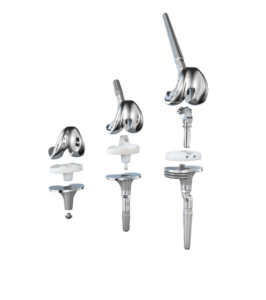
Modular system for limb preservation

The KAM-TITAN knee arthrodesis system is used when a knee endoprosthesis is no longer an option, e.g. after failed septic knee endoprosthetics or multiple failed revisions or following post-traumatic involving loss or damage to the extensor mechanism.

The design is based on the diaphyseal fixation philosophy of the proven MRP-TITAN system, which has been used successfully in clinical practice since 1993.

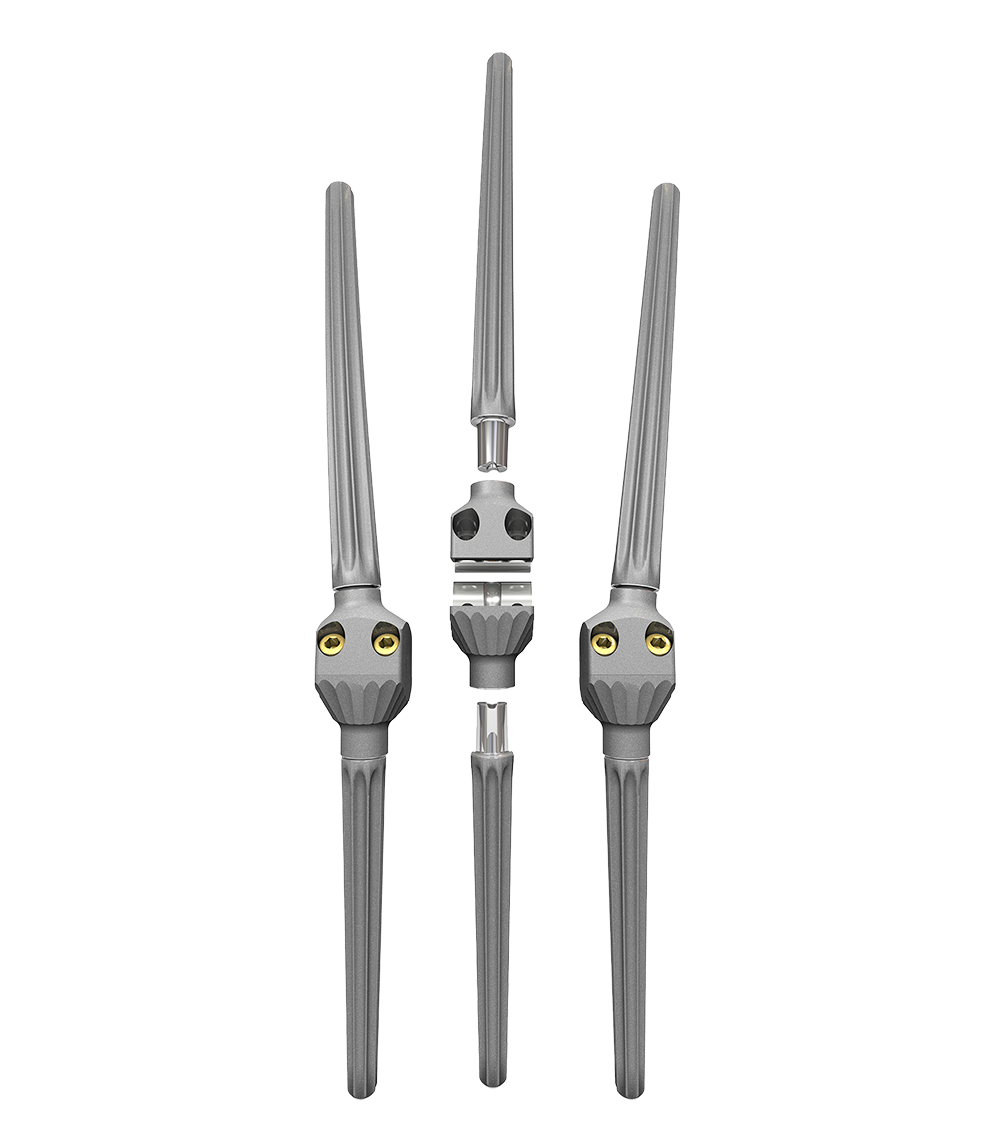
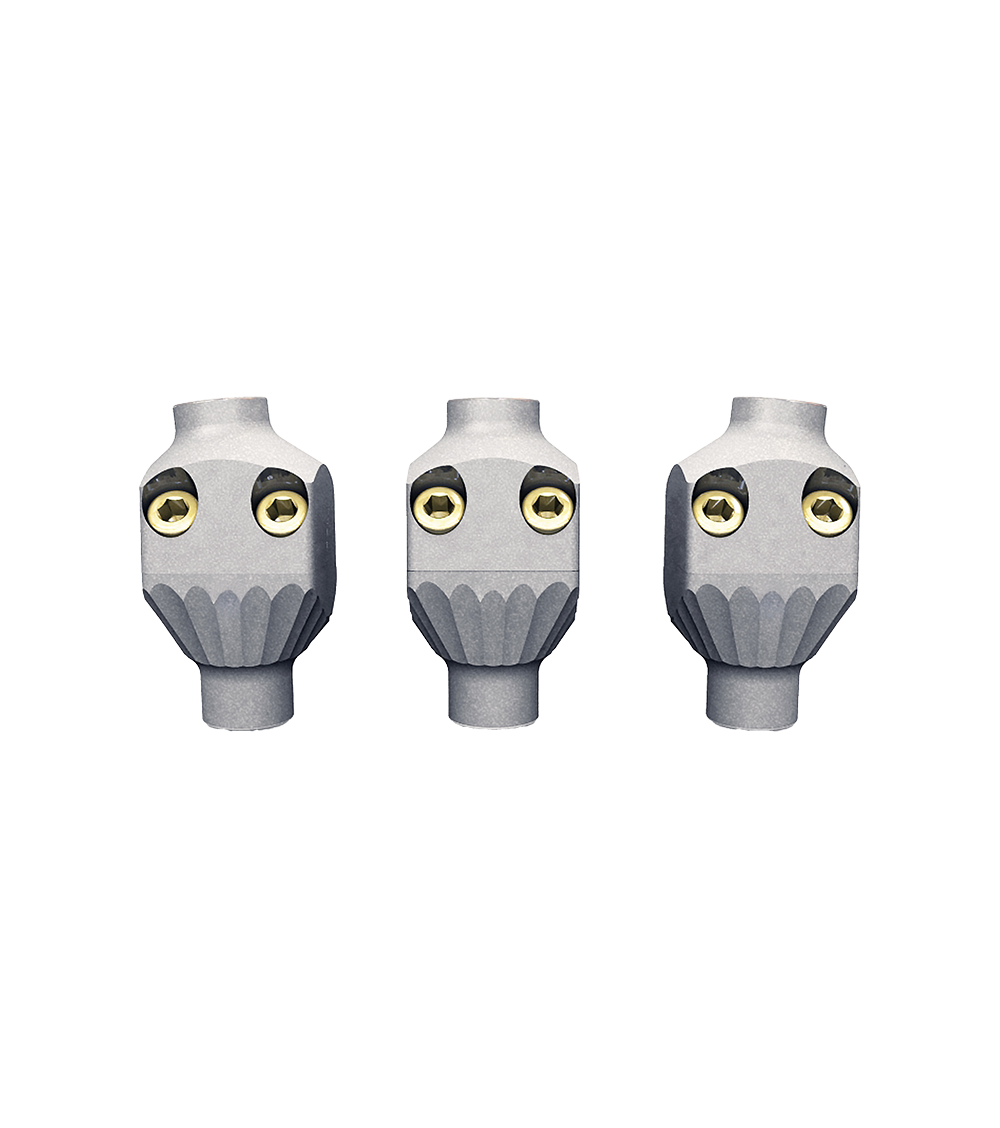
In addition to the neutral module of the KAM-TITAN, anatomic left and right variants are available. The leg axis can therefore be set to 0° or 6° valgus. Even in cases of extremely poor initial bone quality and where there is no prospect of bone union, a secure connection between the upper and lower leg can be achieved using the prosthetic stems and arthrodesis modules.
The cross-section of the cementless prosthesis stems is conical with star-shaped ribs. The surface is textured to promote cementless bone ingrowth.

The ribs are arranged symmetrically in the longitudinal direction and provide protection against rotation, whilst the conical stem geometry reliably counteracts both rotation and subsidence.

Clinically proven

Medium- and long-term clinical results (4,7,8) as well as clinical experience (1,2,3,5,6,9) document the effective treatment provided by the KAM-TITAN knee arthrodesis system.

______________________

Material

  • Proven biocompatible titanium alloy Ti6Al4V
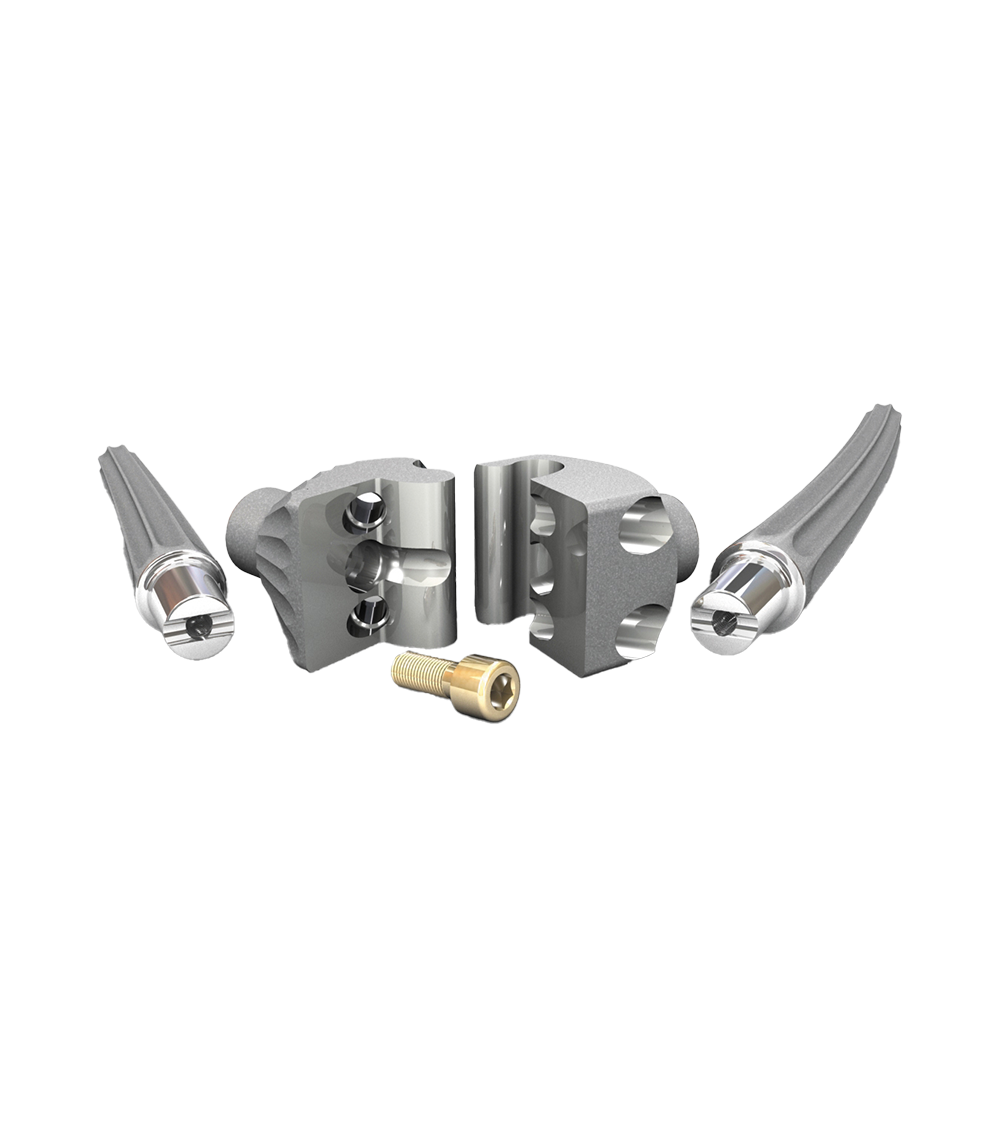
  • Titanium nitride (TiN) coating on the screws

______________________

Design & Function

  • Proven cementless bone-side anchoring through the use of MRP-TITAN prosthetic stems
  • Conical, star-shaped cross-section and continuous longitudinal rib design of the cementless prosthetic stems
  • Alternative cemented stem variants
  • Continuously adjustable external rotation of the lower leg
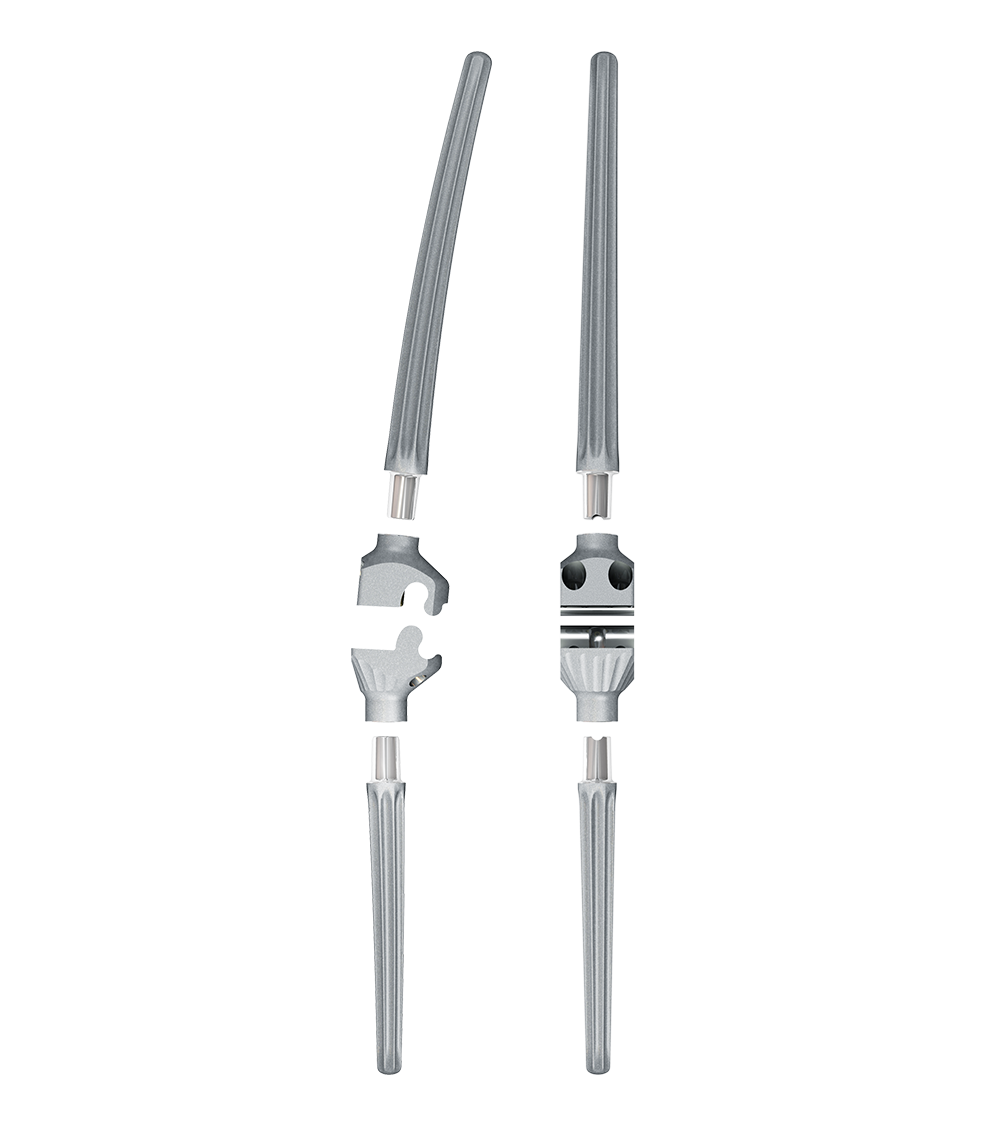
  • Established, reproducible connection and securing of the conical plug-in joint between the prosthesis stem and arthrodesis module
  • Secure coupling of the tibial and femoral arthrodesis components
  • Variable varus angle: neutral 0° or 6° left/right at 7° flexion
  • Tibial and femoral arthrodesis modules coupled in flexion from 35°

______________________

Sizes & Variants

  • Universal neutral tibial arthrodesis module
  • Femoral arthrodesis modules for 0° or 6° varus (left/right) with 7° flexion
  • Cementless prosthetic stems, straight, lengths 140 mm and 200 mm (Ø 13–30 mm)
  • Cementless curved prosthetic stems, lengths 200 mm (Ø 13–30 mm), 260 mm and 320 mm (Ø 11–29 mm)
  • 1 mm incremental diameters of the cementless prosthetic stems
  • Straight cemented prosthetic stems, lengths 140 and 200 mm (Ø 12 mm)

______________________

Advantages

  • Consistent avoidance of CMR substances (carcinogenic, mutagenic, toxic to reproduction) that require labelling → No risk of metal intolerance to cobalt-chromium material
  • Fine-tuned adjustment of leg length and continuous adjustment of lower leg external rotation
  • Construction using trial implants in situ
  • Withdrawal options available at any time
  • Simple instrumentation technique
  • Immediate weight-bearing capacity due to high primary stability
  • Early mobility
  • Clinically proven (1–9)

Downloads

Here you will find product information. This includes the instrumentation guide (surgical technique), summaries of scientific articles (executive summaries), and clinical case reports.

Surgical Technique
KAM-TITAN
Slap hammer
Implant removal set
Executive Summaries
KAM-TITAN
Productportfolio Knee
  1. Schnetz M, Maluki R, Ewald L, Klug A, Hoffmann R, Gramlich Y. Above-knee amputation shows higher complication and mortality rates in line with lower functional outcome compared to knee arthrodesis in severe periprosthetic joint infection. Bone Joint J. 2024;106-B(7):669-679. https://pubmed.ncbi.nlm.nih.gov/38946307/
  2. Sha VI, Patil J, Shetty GM, Sinha AK, Gujjar P. Modular intramedullary knee arthrodesis in perisitent periprosthetic joint infection: The Indian experience. JOREP 2024;3: 100289 https://doi.org/10.1016/j.jorep.2023.100289/
  3. Gramlich Y, Parvizi J. Enough is enough: salvage procedures in severe periprosthetic joint infection. Arthroplasty. 2023 Jul 3;5(1):36. doi: 10.1186/s42836-023-00182-7. PMID: 37394449; PMCID: PMC10316561. https://pubmed.ncbi.nlm.nih.gov/37394449/
  4. Gramlich Y, Steinkohl D, Kremer M, Kemmerer M, Hoffmann R, Klug A. Modular knee arthrodesis secures limb, mobility, improves quality of life, and leads to high infection control in periprosthetic knee infection, when revision knee arthroplasty is not an option. Arch Orthop Trauma Surg. 2021;141(8):1349-1360. https://pubmed.ncbi.nlm.nih.gov/33893531/
  5. Gathen M, Schmolders J, Wimmer MD, Gravius N, Randau TM, Gravius S, Friedrich M. Modulares Kniearthrodesesystem TITAN (KAM-TITAN) nach fehlgeschlagener Knieendoprothetik : Operative Technik und klinische Ergebnisse [Modular arthrodesis system TITAN (KAM-TITAN) after failed revision total knee arthroplasty : Operative technique and clinical experience]. Oper Orthop Traumatol. 2020;32(1):58-72. https://pubmed.ncbi.nlm.nih.gov/31243472/
  6. Corona PS, Lung M, Rodriguez-Pardo D, Pigrau C, Soldado F, Amat C, Carrera L. Acute periprosthetic joint infection due to Fusobacterium nucleatum in a non-immunocompromised patient. Failure using a Debridement, Antibiotics + Implant retention approach. Anaerobe. 2018;49:116-120. https://pubmed.ncbi.nlm.nih.gov/29307651/
  7. Friedrich MJ, Schmolders J, Wimmer MD, Strauss AC, Ploeger MM, Wirtz DC, Gravius S, Randau TM. Two-stage knee arthrodesis with a modular intramedullary nail due to septic failure of revision total knee arthroplasty with extensor mechanism deficiency. Knee. 2017;24(5):1240-1246. https://pubmed.ncbi.nlm.nih.gov/28622842/
  8. Hungerer S, Kiechle M, von Rüden C, Militz M, Beitzel K, Morgenstern M. Knee arthrodesis versus above-the-knee amputation after septic failure of revision total knee arthroplasty: comparison of functional outcome and complication rates. BMC Musculoskelet Disord. 2017;18(1):443. https://pubmed.ncbi.nlm.nih.gov/29132347/
  9. Hasselberg H, Müller F, Zellner M, Krieg B, Bäuml C, Füchtmeier B. Outcome of Knee Joint Arthrodesis as a Salvage Procedure after Periprosthetic Infection: An Analysis of 41 Patients. Int. J. of Orth. 2016;3(3): 571-576

Ready for your next knee revision?

Drei verschiedene Ausführungen des BPK-S Integration Systems zeigen die modulare Bauweise, Semi-Constrained (SC) und Hinge (RH/TH) Mechanismus

BPK-S Integration revision knee system

Knee – Revision
Tibiakonen Metaphysär, metallischer Knochenersatz zur Defektsanierung

TIBIAL CONE Metaphyseal

Knee – Revision
KAM-Titan im Bein

Custom-made-implants

KAM-Monoblock