
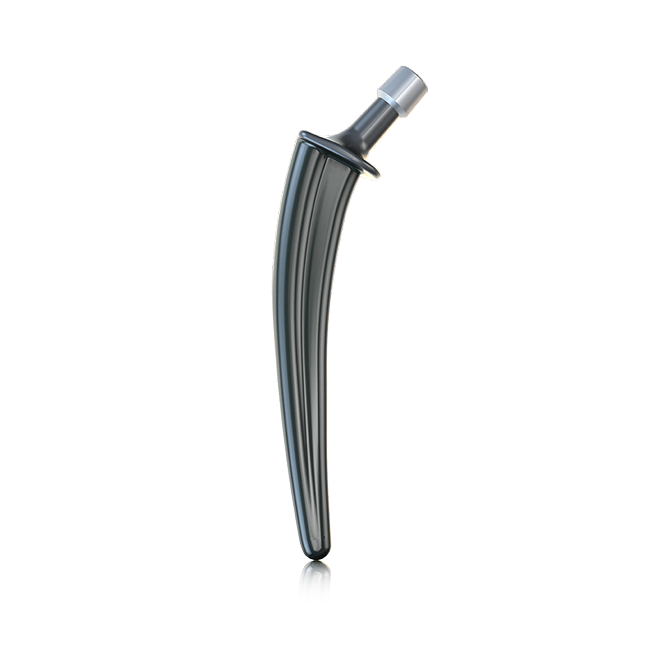
Optimised stem for cemented primary fixation
Optimised stem for cemented primary fixation
For users who expect more from cemented hip stems
- The innovative silicate/silane surface coating COVABOND (silicate silane, poly-MA) creates a hydrolysis-stable chemical bond between the stem and the bone cement.
→ Significantly improved bond strength between cement and implant compared to uncoated cemented CoCr stems.
→ Significant reduction in cement fractures
- The COVABOND coating is a promising solution in relation to cement disruption and aseptic loosening of femoral components at the implant-cement interface in cemented stems.
- Prevention of adverse reactions to cobalt and chromium, which can lead to premature revision, through the consistent avoidance of cobalt-chromium materials
______________________
Material
- Proven biocompatible titanium alloy Ti6AlV4
- Unique silicate/silane-modified surface coating COVABOND (silicate silane, poly-MA)
______________________
Design & Function
- The proven characteristics of established stem types have been systematically incorporated into the design
- The conical shape with rounded edges ensures harmonious load transfer within the cement mantle
- The load-bearing structures of the Adams’ arch, the femoral neck cortex and the calcar femoris are preserved
- Self-stabilisation against sinking is provided by the conical stem shape and the prosthetic collar
- Increased cement compression during implantation due to the conical shaft shape and the prosthesis collar
- High rotational stability due to the flat, hexagonal shaft profile
- Uniform cement jacket over the entire length of the implant
- Optimal force transmission into the femur thanks to the biomechanically and anatomically ideal CCD angle of 138° and the large-surface-area of the prosthesis collar.
______________________
Advantages
- Significantly improved bond strength between cement and implant compared to uncoated cemented CoCr stems
- Consistent avoidance of CMR substances (carcinogenic, mutagenic, toxic to reproduction) subject to labelling requirements
→ No risk of metal intolerance to cobalt-chromium material
- Ideal alternative for patients with metal sensitivity
Downloads
Here you will find product information. This includes the instrumentation guide (surgical technique), summaries of scientific articles (executive summaries), and clinical case reports.
Surgical Technique
AEON-System
AEON-System